


CES 2024 Innovation Awards Honoree
H-FlexTailored to users, Customizable wearable robots
Category Robotics
View on CES.techHello from Hurotics!
Today we would like to share a slightly unusual hands-on experience from our team. We set out to answer the question, "How can H-Medi, our wearable robot, help people with hemiplegia walk?"

CEO Giuk Lee putting on a hemiplegia simulation suit and checking the movement restrictions it creates
When hemiplegia develops after a stroke, it becomes hard to move one arm or leg freely. When walking in particular, a person may not be able to put enough force through one leg or may struggle to swing the foot forward, so steps become shorter and walking can become unsteady. Could a wearable robot for gait rehabilitation ease these difficulties, even a little? Members of the Hurotics team put on a hemiplegia simulation suit and tried H-Medi's walking assistance for themselves.
In fact, H-Medi is already used in clinical settings for rehabilitation training for people who have difficulty walking after a stroke. It is being used with patients at hospitals such as Severance Hospital in Sinchon, and clinical studies are examining how walking function changes. But what would it be like for our own team to use the wearable robot we built to help patients, while experiencing similar restrictions ourselves? That question is where this experience began.
To start with the conclusion: in this internal trial, we saw signs that with H-Medi's assistance, it may be possible to take longer, more consistent steps and to feel steadier when planting the foot. Of course, a single session did not bring hemiplegic gait all the way back to a normal walk. And this was not rehabilitation training with actual patients, only a simple internal trial using a hemiplegia simulation suit.
Let us walk you through what we did and what we felt, step by step.
Why is walking hard for people with hemiplegia?
Most of us hardly think about walking. But a single step takes more movement than you might expect. While one foot supports the body, the other leg swings forward, and then the weight shifts to prepare for the next step. Walking is stable only when this sequence repeats smoothly on both legs.
With hemiplegia, this is not easy. The affected leg may not take enough force, or swinging the foot forward may not go smoothly, so steps can become shorter and walking can become asymmetric between the left and right sides. That is why gait rehabilitation for hemiplegia is not just about walking a lot. Each movement matters: supporting body weight, stepping the foot forward and linking into the next step.
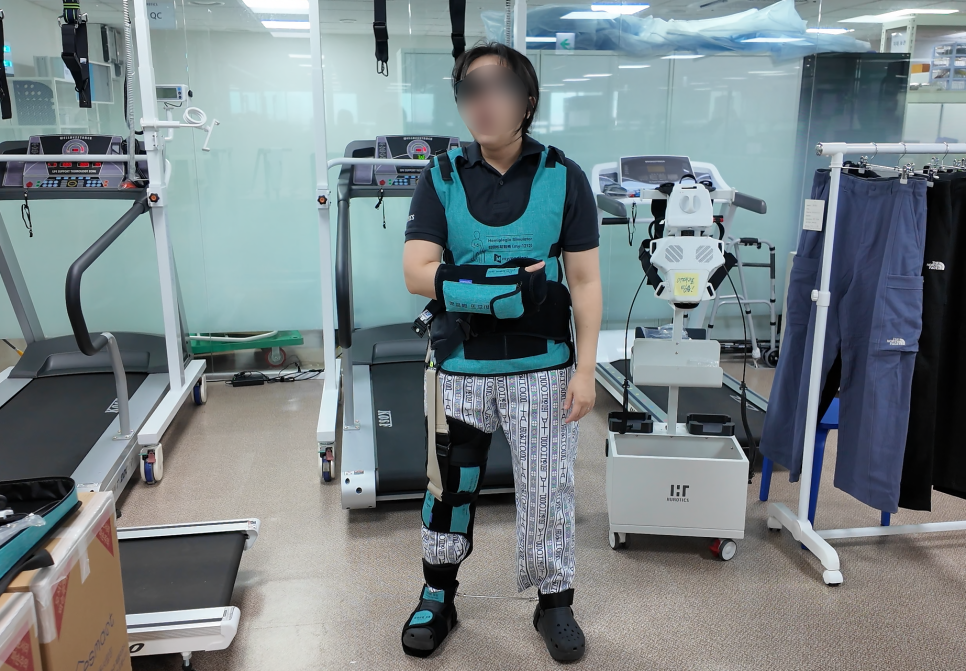
A team member wearing the hemiplegia simulation suit and experiencing its movement restrictions
We put on the hemiplegia simulation suit ourselves. With our arms and legs restricted, movements we normally make without a thought felt awkward, starting with a single step. Our steps naturally got shorter, and we had to pay much more attention to keeping our balance. Of course, a simulation suit alone cannot capture all of the muscle weakness and neurological difficulties that people with hemiplegia actually experience. Still, feeling restrictions on walking that we never normally notice made us think again about the moments when our robot should lend its strength.
So what changes when you wear H-Medi?
H-Medi is a soft exosuit worn like clothing. Rather than moving the legs with a rigid metal frame, it is a wearable robot that uses fabric, cables (tendons) and sensors to deliver the assistance needed for walking. Put simply, while the person walks on their own, the robot adds assistance at the moments in each step when force is needed.

Wearing H-Medi over the hemiplegia simulation suit
While wearing the hemiplegia simulation suit, we compared our movement before and after H-Medi's assistance was applied.
The first thing we looked at was step length. With only the simulation suit, stepping the leg forward was restricted, so steps tended to be short. Once H-Medi's assistance was added, we could see the next step being taken with a slightly longer stride.
The second was planting the foot and supporting the body. When we walk, one leg supports the body while the other moves forward, and if there is not enough force to move forward at that moment, the next step naturally ends up smaller. In this trial, with H-Medi's assistance, supporting the body over the planted foot and stepping out with the next foot also felt noticeably steadier.

Trying out walking in the hallway
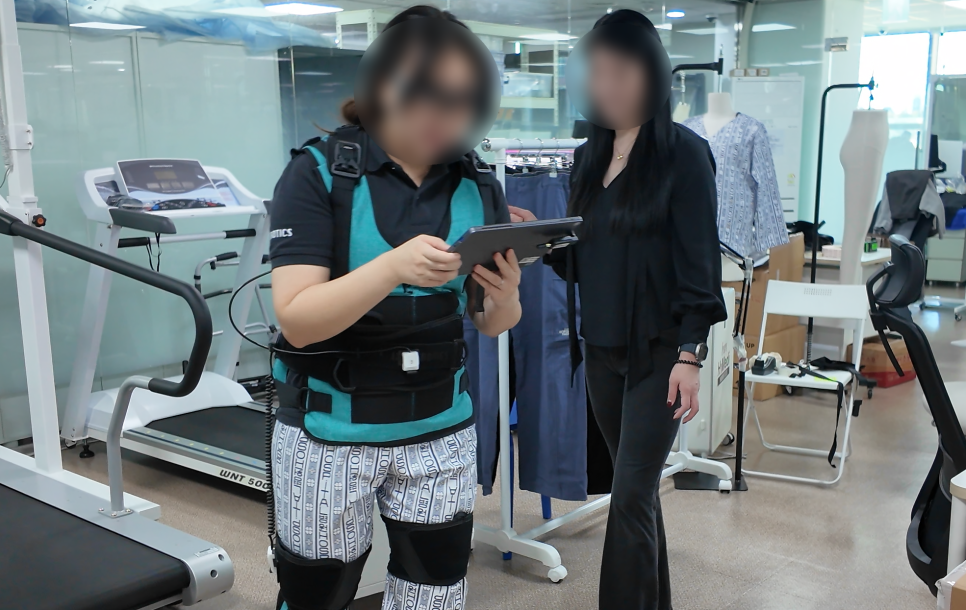
Checking the changes in walking on a tablet
So, can people with hemiplegia use H-Medi?
H-Medi is a wearable robot for gait rehabilitation used in medical institutions such as hospitals. For people with hemiplegia, too, medical staff assess walking ability, balance, muscle strength, safety and other factors before deciding whether H-Medi can be used, so it does not apply in the same way to every patient with hemiplegia. If you are wondering about the criteria, the general guide is a Functional Ambulation Category (FAC) of 2 or higher, with some remaining ability to walk on one's own.
This trial was neither rehabilitation training for patients nor research. It was a chance for our development team to feel firsthand at which moments our robot's assistance comes in. Compared with the difficulties patients face with every step, every day, it was a very short experience, but it made clear what we need to build better. We will keep sharing moments like this!
The photos in this post show an internal gait test that Hurotics team members carried out using a hemiplegia simulation suit. They are not results from a clinical trial with patients with hemiplegia.
CES 2024 Innovation Awards Honoree
H-FlexTailored to users, Customizable wearable robots
Category Robotics
View on CES.tech
CES 2025 Innovation Awards Honoree
H-MediAll-in-one Gait Rehabilitation and Prognosis
Category Accessibility & Longevity, Robotics
View on CES.tech
CES 2026 Innovation Awards Honoree
H-Medi ProComfortable Personalized Robotic Suit for Targeted Recovery
Category Robotics
View on CES.tech[04315] HUROTICS Inc., 13F, Yongsan The Prime, 11, Wonhyo-ro 90-gil, Yongsan-gu, Seoul, Republic of Korea
Hurotics Inc. (hereinafter referred to as the "Company") establishes and discloses the following personal information processing guidelines to protect the personal information of data subjects and handle related grievances promptly and smoothly in accordance with Article 30 of the Personal Information Protection Act.
The Company processes personal information for the following purposes. The personal information being processed will not be used for purposes other than the following, and if the purpose of use changes, necessary measures will be taken, such as obtaining separate consent in accordance with Article 18 of the Personal Information Protection Act.
- Within 3 years from the date of receipt of website customer inquiries
- Request to view personal information
- Request for correction in case of errors
- Request for deletion
- Request to stop processing
- Required items: Name, Contact information (phone number, email address), Company name
- IP address, cookies, MAC address, service usage records, visit records, malicious use records, etc.
- Destruction procedure
The Company selects personal information for which destruction reasons have occurred and destroys it with the approval of the Company's personal information protection officer.
- Destruction method
Personal information printed on paper is destroyed by shredding or incineration. Personal information stored in electronic file format is deleted using technical methods that prevent recovery of the records.
Posted: December 19, 2025