


CES 2024 Innovation Awards Honoree
H-FlexTailored to users, Customizable wearable robots
Category Robotics
View on CES.tech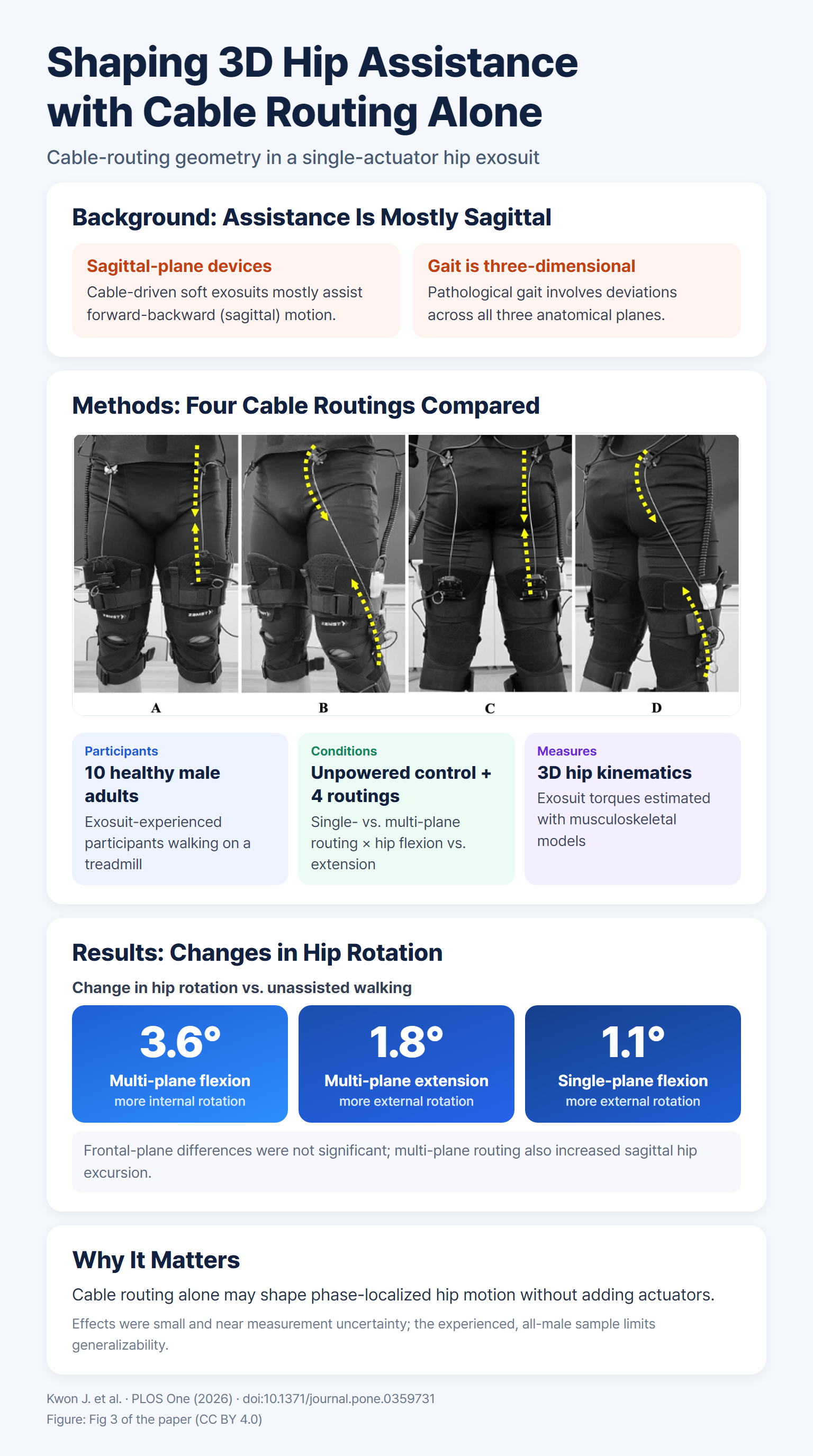
Author: Junhyeong Kwon, Sejun Park, Harry George Driscoll, Giuk Lee
Corresponding author: Giuk Lee
Journal: PLOS One
Published date: 2026.10
Link: https://journals.plos.org/plosone/article?id=10.1371/journal.pone.0359731
DOI: 10.1371/journal.pone.0359731
본 연구는 액추에이터가 하나뿐인 힙 엑소슈트에서 케이블 경로(라우팅) 설계만으로 고관절의 3차원 움직임에 영향을 줄 수 있는지 확인하기 위해 진행되었습니다. 케이블 구동 소프트 엑소슈트는 대부분 앞뒤 방향(시상면) 움직임만 보조하지만, 실제 병적 보행에서는 세 해부학적 평면에 걸친 편차가 함께 나타납니다. 엑소슈트 착용 경험이 있는 건강한 성인 남성 10명이 무동력 대조 조건과, 단일 평면·다평면 케이블 경로를 고관절 굴곡·신전 보조와 짝지은 네 가지 조건으로 트레드밀을 걸었고, 연구진은 3차원 고관절 운동학과 근골격 모델로 추정한 엑소슈트 토크를 비교했습니다.
연구 결과, 다평면 경로에서는 보행 주기 단계에 따라 주로 수평면(회전) 움직임이 변했습니다. 보조하지 않은 보행과 비교해 다평면 굴곡 보조는 고관절 내회전을 3.6°, 다평면 신전 보조는 외회전을 1.8° 늘렸고, 단일 평면 굴곡 보조도 외회전을 1.1° 늘렸습니다. 관상면 차이는 어느 조건에서도 유의하지 않았으며, 다평면 경로는 시상면 고관절 운동 범위도 더 크게 만들었습니다. 연구진은 액추에이터를 늘리지 않고 케이블 경로만으로 고관절 움직임을 조절할 수 있는 가능성을 확인했다고 밝혔습니다. 다만 효과 크기가 작아 측정 오차 수준에 가깝고 경험 있는 남성 참가자만 대상으로 해, 케이블 경로는 아직 확립된 설계 변수가 아니라 후보로 제안되었습니다.
This study examined whether cable-routing geometry alone, within a single-actuator hip exosuit, can produce measurable multiplanar hip effects during walking. Cable-driven soft exosuits are predominantly sagittal-plane devices, yet pathological gait involves coordinated deviations across all three anatomical planes. Ten healthy, exosuit-experienced male adults walked on a treadmill under an unpowered control and four powered configurations pairing single-plane and multi-plane cable routing with hip-flexion and hip-extension assistance.
Multi-plane routing produced phase-dependent kinematic changes concentrated in the transverse plane. Relative to unassisted walking, multi-plane flexion assistance increased hip internal rotation by 3.6°, multi-plane extension assistance increased external rotation by 1.8°, and single-plane flexion assistance increased external rotation by 1.1°. Frontal-plane differences were not significant, and multi-plane routing also produced greater sagittal-plane hip excursion. The effect magnitudes were small and near the measurement uncertainty, and the all-male, experienced sample limits generalizability, so cable-routing geometry is proposed as a candidate rather than an established design variable.
Funding information:
National Research Foundation of Korea (NRF) funded by the Korea government (MSIT)
Industrial Strategic Technology Development Program funded by the Ministry of Trade, Industry and Energy (MOTIE, Korea)
CES 2024 Innovation Awards Honoree
H-FlexTailored to users, Customizable wearable robots
Category Robotics
View on CES.tech
CES 2025 Innovation Awards Honoree
H-MediAll-in-one Gait Rehabilitation and Prognosis
Category Accessibility & Longevity, Robotics
View on CES.tech
CES 2026 Innovation Awards Honoree
H-Medi ProComfortable Personalized Robotic Suit for Targeted Recovery
Category Robotics
View on CES.tech[04315] HUROTICS Inc., 13F, Yongsan The Prime, 11, Wonhyo-ro 90-gil, Yongsan-gu, Seoul, Republic of Korea
Hurotics Inc. (hereinafter referred to as the "Company") establishes and discloses the following personal information processing guidelines to protect the personal information of data subjects and handle related grievances promptly and smoothly in accordance with Article 30 of the Personal Information Protection Act.
The Company processes personal information for the following purposes. The personal information being processed will not be used for purposes other than the following, and if the purpose of use changes, necessary measures will be taken, such as obtaining separate consent in accordance with Article 18 of the Personal Information Protection Act.
- Within 3 years from the date of receipt of website customer inquiries
- Request to view personal information
- Request for correction in case of errors
- Request for deletion
- Request to stop processing
- Required items: Name, Contact information (phone number, email address), Company name
- IP address, cookies, MAC address, service usage records, visit records, malicious use records, etc.
- Destruction procedure
The Company selects personal information for which destruction reasons have occurred and destroys it with the approval of the Company's personal information protection officer.
- Destruction method
Personal information printed on paper is destroyed by shredding or incineration. Personal information stored in electronic file format is deleted using technical methods that prevent recovery of the records.
Posted: December 19, 2025