Hurotics H-Medi
Hello from Hurotics!
As more people have come to know Hurotics, we have been receiving a lot of inquiries through our website and office, especially from patients and their families: "Can I use H-Medi too? Where can I try it? How much does it cost?"
H-Medi is equipment used in medical institutions such as rehabilitation hospitals, convalescent rehabilitation hospitals, spine and joint hospitals, orthopedic clinics and long-term care hospitals. At the moment, individuals cannot purchase it to use on their own at home. (A personal version is in the works!)
Still, we wanted to make it quicker and easier for you to find out whether H-Medi suits your situation and, if it does, where to go. So in this post we will answer the question, "Who can use H-Medi, the Hurotics gait rehabilitation exosuit?" We will also explain why we call H-Medi an "exosuit" rather than a "wearable robot," even though the word may still be unfamiliar.
What is H-Medi?
H-Medi is a soft exosuit for gait rehabilitation developed by Hurotics, and it is a medical device.
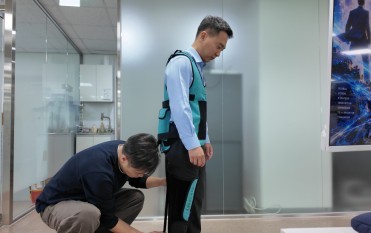
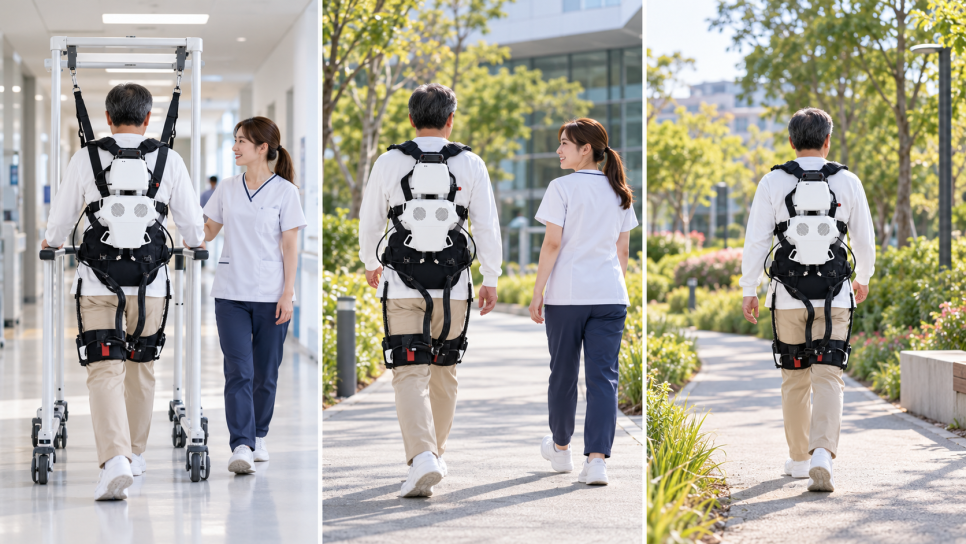
Unlike the wearable robots you may have seen, which attach a heavy metal frame to the body, H-Medi is made of fabric and cables and is worn like clothing.
The controller, actuator and battery are discreetly built into the garment. Cables that work like the tendons of your muscles transmit force to the hip joint, assisting the motions of planting the foot and pushing the leg backward.
IMU sensors read the wearer's gait in real time, step by step, and add only as much force as is needed, exactly when it is needed, matched to each person's walking pattern (assist-as-needed). Whether you walk fast or slowly, go uphill or downhill, climb stairs or change direction, it helps just enough for that moment and situation. That is why it is used so widely, from rehabilitation hospitals, convalescent rehabilitation hospitals and long-term care hospitals to rehabilitation after spine and joint surgery.
Why can a soft exosuit serve such a wide range of patients?
Unlike conventional robots, a single device can be used for the rehabilitation of both patients with neurological conditions and patients recovering from orthopedic surgery. The reason lies in the structure of the soft exosuit itself.
No frame: lightweight, with no restriction of movement.
An exoskeleton robot can only move in the directions its mechanical joints allow. H-Medi does not limit the range of motion of the patient's hips, knees or ankles, so patients can sit down, stand up, turn and climb stairs naturally, the way they normally move.
Tendon-driven: no extra load on the joints.
With a rigid exoskeleton, abnormal forces act on the joint when the robot's mechanical joint axis and the person's joint axis are misaligned. H-Medi transmits force through cables, like the tendons of a muscle, so there is no joint axis to align (zero misalignment). It can be used even on joints that have been operated on or are deformed.
Assistance only as needed.
The level of assistance can be adjusted to the patient's condition and gait cycle, so the same device can be used to train patients who need hands-on support to walk as well as patients who walk independently but need to improve the quality of their gait.
Walking outdoors: overground gait training.
Its compact size allows it to be combined with a mobile harness, so patients can train in the environments they actually need to return to: therapy room hallways, stairs, ramps and the outdoors. It can also be used directly for post-surgery training to return to daily life and for assessment before discharge.
Please keep in mind
H-Medi is a medical device, so it is not a product that individuals buy for home use. You can get a consultation at a nearby hospital in Korea that has adopted H-Medi. A personal exosuit is under development with a target of next year, so please stay tuned. For H-Medi, the fastest way is to contact a hospital near you: a rehabilitation hospital, convalescent rehabilitation hospital, long-term care hospital or spine and joint surgery hospital.