Wearable robots are evolving from exoskeletons into clothing
Hello from Hurotics.
When we introduce H-Medi as "a wearable robot," many people picture the metal armor they have seen in movies: a rigid, heavy frame along the legs with a motor at every joint. But when they actually see H-Medi, they say, "This is a robot? It looks like clothing."
That's right. It is not something that looks like clothing. It is a robot you wear like clothing, and that is exactly what an exosuit is.
So today, we will set the product aside for a moment and give a simple explanation of exosuit technology itself: how it differs from exoskeleton robots, where and how it was born, and how it works.
It is a little long, but we have tried to write it so that this one post is all you need to understand exosuits!
Let's go through it one step at a time.
There are two kinds of wearable robots: exoskeletons and exosuits
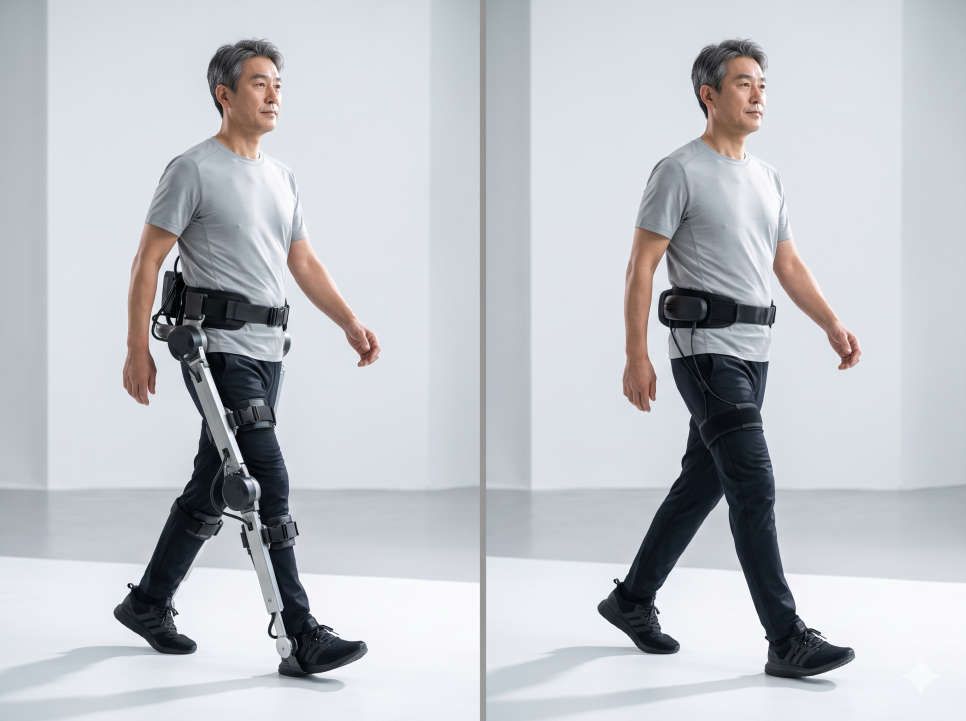
Left: an example of an exoskeleton / Right: an example of an exosuit
Robots worn on the body can be broadly divided into two types, depending on their structure and how they transmit force.
Exoskeleton
This is the robot you probably already know. A heavy metal or plastic frame runs alongside the body, and motors on the frame's joints generate force. Exoskeletons can deliver strong assistance and are well suited to precisely controlling movement along a set trajectory. Some exoskeleton robots can even help patients who cannot stand on their own to stand up and walk.
Exosuit
An exosuit does not use a heavy external frame. It transmits force through functional textiles and cables, and uses the wearer's own bones as the robot's skeleton. The actuators (motors) are placed near the body's center of mass, and cables deliver force to the joints. Because there is no separate mechanical joint axis, the problem of the robot's joint axes being misaligned with the person's is avoided. You know the jerky "robot dance"? That is the kind of movement you get when joint axes are misaligned.
How the names of wearable robots reflect their evolution
The name "exoskeleton" has been in use since the 1960s, borrowed from the external skeletons of insects. For the following half century, one of the main directions in exoskeleton development was to make frames lighter, thinner and fewer. Materials changed and structures became more sophisticated, but the heavy frame never went away.
Around 2011, an approach that does away with rigid, heavy frames altogether began to attract serious attention. The name that became widely known at this time was the "soft exosuit": a design that transmits force through functional textiles and cables and uses the human body as its supporting skeleton.
Today, academia and industry often drop the word "soft" and simply say "exosuit," since a soft, flexible structure is already part of the concept. Papers published in major journals since 2023 use "exosuit" on its own in their titles.
So if you have noticed Hurotics using both "soft exosuit" and "exosuit," they refer to the same technology.
The history of wearable robots is also a history of efforts to make frames lighter and movement more natural. Within that history, the exosuit is the wearable robot that has removed the heavy frame and is opening up new possibilities.
Problems exoskeletons have long struggled to solve
Wearing a robot can let you produce more force. At the same time, the weight of the robot can add to your burden.
This is the very problem that heavy, rigid exoskeletons have wrestled with for half a century, and it is not the only one. Here are the main issues that come up again and again in review papers.
Weight and bulk
The weight of the frame, battery and other parts increases the system's inertia. Simply wearing the robot can increase the energy needed to move.
Restricted natural joint movement
Rigid links and joint structures limit the natural movement and range of motion of human joints.
Joint axis alignment
If the robot's axis of rotation is offset from the center of rotation of the human joint, the robot can apply force in directions the wearer did not intend. These forces can also concentrate as pressure where the robot contacts the body, which is why this issue receives particular attention in exoskeleton design.
Distal inertia
Adding weight to fast-moving extremities such as the ankles or wrists makes control harder and can interfere with natural movement.
Why is alignment so hard to solve?
Because human joints are built differently from mechanical ones.
The knee is not a simple hinge, and the full movement of the shoulder is hard to explain with a simple ball-and-socket model. In some joints, the center of rotation itself shifts as the joint bends and straightens. Because of this kinematic complexity, researchers point out that perfectly aligning a rigid exoskeleton with human joints is extremely difficult (Frontiers in Neurorobotics, 2026).
Precision machining, better materials or additional joint mechanisms can reduce the error, but they cannot eliminate it for every movement. The moment you create a mechanical joint axis, you have to match it to the human joint axis. The alignment problem of exoskeletons is not just a matter of craftsmanship. It is tied to their structure. Over half a century, many of these problems have gradually improved, but they have not disappeared.
So the new approach that began drawing serious attention in the early 2010s asked a different question instead of fixing these problems one by one:
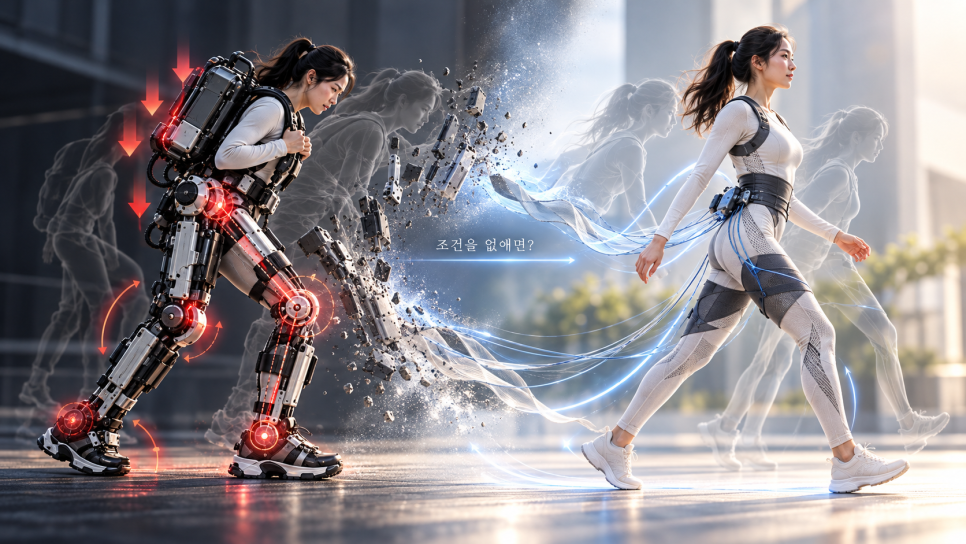
"What if we removed the conditions that create these problems in the first place?"
Where did the exosuit come from? From DARPA to Harvard, and the beginning of Hurotics!
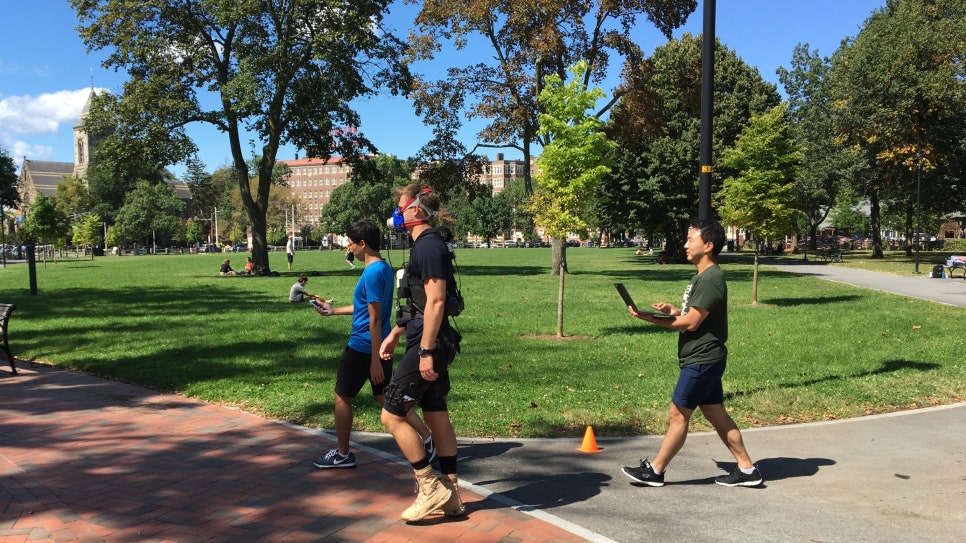
Hurotics CEO Giuk Lee conducting exosuit research at Harvard's Wyss Institute
The starting point was not the hospital but the battlefield.
Gunshot wounds were not the main reason U.S. soldiers were medically discharged. Of U.S. Army medical discharges from 2011 to 2016, about 70% involved musculoskeletal injuries. Non-combat musculoskeletal injuries were more common than combat injuries and were also the most common reason for early discharge (Molloy et al., Military Medicine, 2020). Walking with a full combat load of up to 45 kg was placing a heavy burden on soldiers' bodies.
In 2011, the U.S. Defense Advanced Research Projects Agency (DARPA) launched a program called "Warrior Web."
The requirements were demanding: assist the work of the muscles and reduce injuries without significantly changing the uniform. Target joints included the ankles, knees, hips, lower back and shoulders. Conventional exoskeletons had difficulty meeting these requirements, as they were bulky, could be noisy and were burdensome to wear for long periods.
Faced with the condition "don't significantly change the uniform," building a heavy frame had clear limits.
The idea that gained attention was something like a wetsuit: a garment that fits closely to the body, a robotic undergarment made of fabric. This is where the concept of the "exosuit" really began to develop. Several institutions took part in Warrior Web, and one of those that actively advanced the textile-based approach was the Harvard Biodesign Lab at the Wyss Institute, where our CEO also worked! The lab was led by Professor Conor Walsh, and in September 2014 DARPA awarded the team a follow-on contract worth $2.9 million.
In other words, the exosuit was not born from "let's build a stronger robot," but from the question, "How can we assist movement with something you wear like clothing?"
The era of rigid, heavy frames, and 15 years of exosuits
Wearable robots have a long history even before exosuits.
A patent for a spring-based walking aid was granted in 1890 (Nicholas Yagn), and in the 1960s GE's Hardiman represented the early full-body powered exoskeletons. Weighing hundreds of kilograms, however, it was never put to practical use. In the 2000s, frame-based technology advanced through military exoskeletons such as BLEEX, XOS and HULC, and in the 2010s medical exoskeletons such as ReWalk, Ekso and HAL were commercialized.
The roughly 15 years since 2011 have also been a time of proving what frameless robots, exosuits, can do.
Early studies were measured on treadmills with devices connected to external power. Then, in 2019, a fully portable device was shown to assist both walking and running, followed by studies on uphill walking, and in 2023 sprints were measured on an actual track. Research has been moving from the lab to the outdoors, and on to real-world use.
July 2017 was a particularly important turning point. Until then, the focus had mainly been on improving walking efficiency and athletic performance in healthy people. Studies with stroke patients then began to confirm the potential to assist the movement of people with gait impairments. It was a key moment when technology centered on defense and sports expanded into medicine and rehabilitation. Efforts to broaden its applications continue: from loaded military marching to rehabilitation, walking in older adults, children, sports and industrial settings. With H-Fit, H-Care, H-Swing and more, it is no exaggeration to say that Hurotics is leading the expansion of the exosuit. Haha!
And it makes sense. Exosuit research began in the United States, but commercialization and many important research results are now coming out of Korea, with Hurotics CEO Giuk Lee at the center of it. We will cover that story separately next time!
How does an exosuit work?
One of the key design features of an exosuit is "taking the motor off the joint."
The motors are placed where the body can support the load relatively stably, and Bowden cables connect the motors to the joints.
Think of a bicycle brake cable, where an inner cable runs inside an outer sheath. The sheath is fixed to textile anchors, and when the motor pulls the inner cable, that force is transmitted as assistance to the joint's movement.
Our own bodies work on a similar principle. Some of the muscles that move your fingers are located not in the fingers but in the forearm, and their force travels to the fingers through tendons. That is why exosuits are called "tendon-driven."
The device in the 2019 Harvard paper weighed 5 kg in total, with more than 90% of its mass located near the body's center of mass. It was designed not only to reduce weight but also to consider where that weight sits. Even the same 1 kg feels completely different to a walker depending on whether it is on the ankle or at the waist.
So what makes the exosuit different? A summary!

Bulk and silhouette
Having no frame is not only about weight. It is also about how much space the device takes up. Exoskeletons are generally worn over clothing, and in most cases their mechanical structure is exposed. Exosuits, on the other hand, are designed from the start to be worn like clothing or under clothing.
No joint alignment problem
An exosuit does not create a separate mechanical joint axis, so there is no need to match a mechanical joint axis to the human one. Rather than solving the alignment problem more precisely, it removes the structural condition that causes the problem in the first place. Where the textile contacts the body still matters, of course, but the absence of joint axis mismatch is a clear difference. The difference from an exoskeleton is not one of specifications but of structure.
Force efficiency and changes in gait
Exosuits are not designed solely to produce large forces. For assisting standing and walking in people who cannot support their own body weight, heavy but rigid exoskeletons are still the better fit. Exosuits focus on a slightly different measure: how large a change in gait can be produced with an appropriate amount of force. In other words, the focus is on making more efficient use of the walking ability users already have and assisting natural movement.
In short
An exosuit is a wearable robot that transmits force to the body through functional textiles and cables, without a heavy, rigid external metal frame. Because it uses the human body itself as the robot's skeleton, it is lightweight and well suited to preserving natural joint movement, and by design there is no mechanical joint axis to fall out of alignment with the human joint.
The technology began to develop in earnest through programs such as DARPA's Warrior Web in 2011. Today, Hurotics has advanced this exosuit technology and commercialized an exosuit for use in medical and rehabilitation settings! An exosuit is not simply a robot that makes people stronger. It is a technology that assists the user's movement so they can move more efficiently and stably. A robot that makes you healthier when you wear it: that is the exosuit technology Hurotics is working toward.