

Author: Junhyeong Kwon, Donghyun Lee, Hyunsu Choi, Wonhee Lee, Junyoung Moon, Giuk Lee
Corresponding author: Giuk Lee
Journal: IEEE Transactions on Biomedical Engineering
Published date: 2026.08
Link: https://ieeexplore.ieee.org/document/11664302
DOI: 10.1109/TBME.2026.3726470
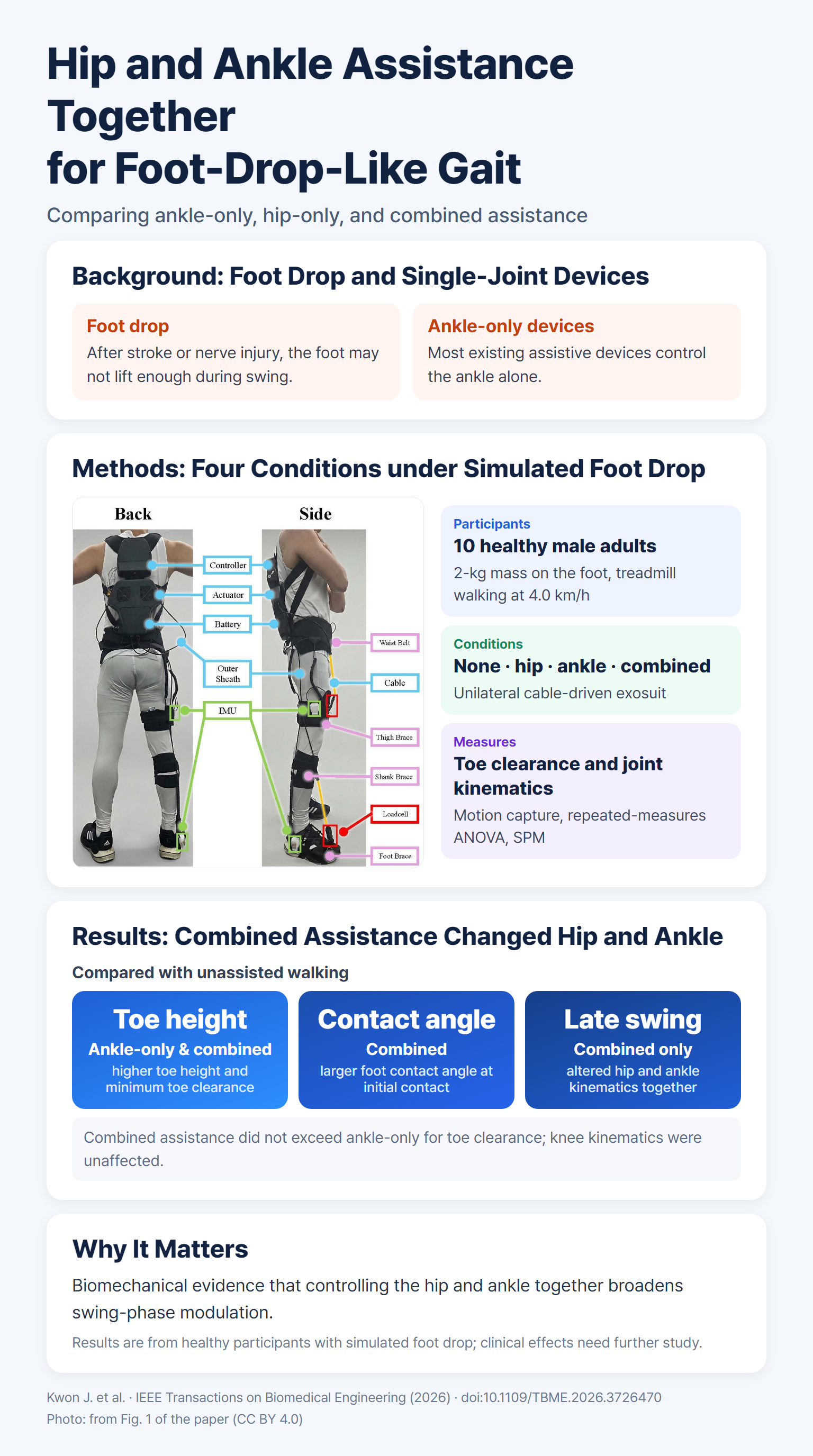
This study evaluated whether coordinated multi-joint assistance within a single-limb soft exosuit produces broader swing-phase kinematic modulation than isolated ankle or hip assistance under a foot-drop-like perturbation. Ten healthy male adults walked on a treadmill at 4.0 km/h with a 2-kg mass on the dorsum of the foot, under four conditions: no assistance, hip-only, ankle-only, and combined hip-ankle assistance delivered by a unilateral cable-driven exosuit built on the H-Medi platform.
Compared with unassisted walking, both ankle-only and combined assistance significantly increased maximum toe height and minimum toe clearance during mid-swing, and both exceeded hip-only assistance in minimum toe clearance. Combined assistance also increased the foot contact angle at initial contact. It did not further increase toe clearance or contact angle over ankle-only assistance, but it uniquely altered both hip and ankle kinematics in late swing, while knee kinematics were unaffected by any condition. The findings provide biomechanical evidence supporting multi-joint soft exosuit strategies for foot clearance, while clinical translation remains to be established.
Funding information:
Chung-Ang University Research Scholarship Grants in 2025
Industrial Strategic Technology Development Program funded by the Ministry of Trade, Industry & Energy (MOTIE, Korea)
- Grant No. 20007058
National Research Foundation of Korea (NRF) grant funded by the Korea government (MSIT)
- Grant No. RS-2025-00555545


