

Author: Junhyeong Kwon, Sejun Park, Harry George Driscoll, Giuk Lee
Corresponding author: Giuk Lee
Journal: PLOS One
Published date: 2026.10
Link: https://journals.plos.org/plosone/article?id=10.1371/journal.pone.0359731
DOI: 10.1371/journal.pone.0359731
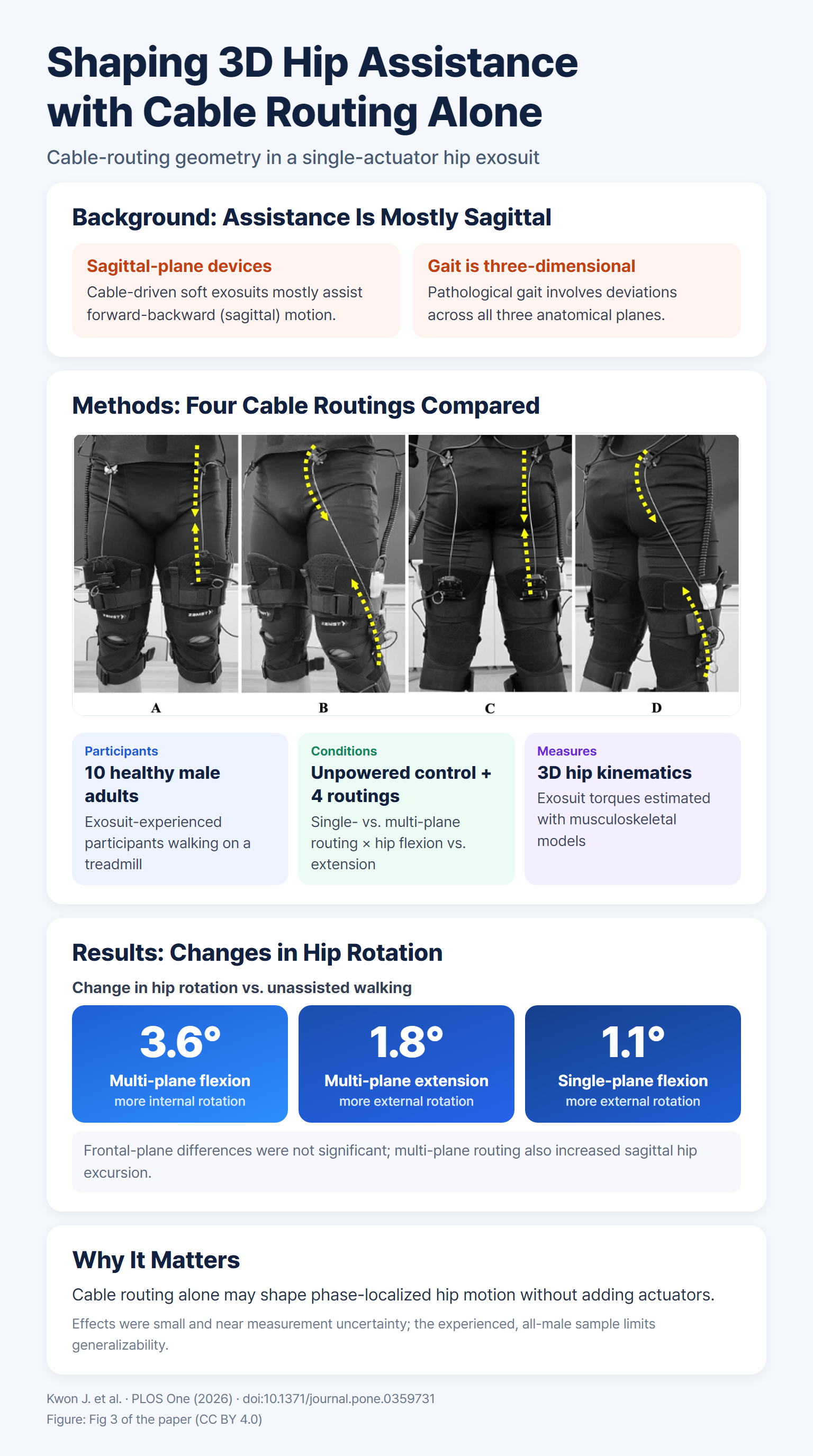
This study examined whether cable-routing geometry alone, within a single-actuator hip exosuit, can produce measurable multiplanar hip effects during walking. Cable-driven soft exosuits are predominantly sagittal-plane devices, yet pathological gait involves coordinated deviations across all three anatomical planes. Ten healthy, exosuit-experienced male adults walked on a treadmill under an unpowered control and four powered configurations pairing single-plane and multi-plane cable routing with hip-flexion and hip-extension assistance.
Multi-plane routing produced phase-dependent kinematic changes concentrated in the transverse plane. Relative to unassisted walking, multi-plane flexion assistance increased hip internal rotation by 3.6°, multi-plane extension assistance increased external rotation by 1.8°, and single-plane flexion assistance increased external rotation by 1.1°. Frontal-plane differences were not significant, and multi-plane routing also produced greater sagittal-plane hip excursion. The effect magnitudes were small and near the measurement uncertainty, and the all-male, experienced sample limits generalizability, so cable-routing geometry is proposed as a candidate rather than an established design variable.
Funding information:
National Research Foundation of Korea (NRF) funded by the Korea government (MSIT)
- Grant No. RS-2025-02216282
- Grant No. RS-2025-00555545
Industrial Strategic Technology Development Program funded by the Ministry of Trade, Industry and Energy (MOTIE, Korea)
- Grant No. 20007058


